From Classroom to Cockpit: A Guide to Becoming a Licensed Pilot in Kenya
Becoming a pilot is a common childhood dream for many people. The journey is both challenging and rewarding. This dream can be achieved through a rigorous and structured process. It requires dedication, education, and commitment.
Want to know how you can become a pilot in Kenya? This guide will walk you through all you need. Let’s dive right in.
-
Age Requirements
Training can commence at any age. However, the Kenya Civil Aviation Authority (KCAA), the aviation regulatory body, has established specific minimum age requirements for obtaining licenses.
To acquire a Private Pilot License (PPL), one must be at least 17 years old, while a Commercial Pilot License (CPL) is 18 years.
-
Education Qualifications
To become a pilot in Kenya, a candidate must have completed high school and obtained a minimum mean grade of C+ in the Kenya Certificate of Secondary Education (KCSE) or an equivalent qualification, with at least C+ in Mathematics, English, and Physics.
Mathematics aids in navigation, weight balance, fuel management, and conversions.
English is crucial for effective communication in aviation.
Physics is essential for understanding flight principles like aerodynamics and propulsion.
These subjects form the foundation for the safe and successful operation of aircraft because they help pilots develop critical thinking skills and problem-solving abilities.
-
Training School
Kenyan flying schools are assessed by the Kenya Civil Aviation Authority (KCAA) for compliance with regulations, safety, instruction quality, facilities, equipment, and student satisfaction.
When selecting a flying school, consider your needs, budget, training type, cost, location, and the school’s reputation.
Visiting and meeting flight instructors before enrolling in a flight school is essential. This allows prospective students to learn more about the training environment, instructors, and available programs.
This is where Flitestar Academy comes in as one of the top-rated Approved Training Organizations (ATO) in Kenya. We are committed to providing high-quality flight training and professional guidance to every student.
At Flitestar, we offer both PPL and CPL. PPL is ideal for individuals who want to fly for recreational or personal purposes. It allows you to enjoy the freedom of flying as a hobby or use an aircraft for personal travel.
CPL is designed for those who want to pursue aviation as a career. It is required for pilots who wish to be paid for their flying services, including airline pilots, cargo pilots, bush pilots, and flight instructors.
We also offer a flexible payment plan that allows students to continue their training with less financial pressure, enabling them to focus fully on achieving their aviation goals.
-
Medical Check-up
Before beginning your training, you must secure a medical certificate from an approved aviation medical doctor.
For PPL, you’ll need to pass a class 2 medical examination, and for CPL, a class 1.
The school will provide a list of aviation doctors who will assess your general health, vision, hearing, and other vital aspects that ensure you can safely operate an aircraft.
For more details, read the ICAO Annex 1 chapter 6.
-
Training
After passing the medical examination, you apply for a Student Pilot License (SPL), which allows you to start training as a student officially.
Pilot training is divided into two parts:
-
Ground school.
During ground school, you learn theory on how airplanes operate. You will cover a total of 8 units, which include Air Law, Aircraft General Knowledge, Flight Performance and Planning, Human Performance, Meteorology, Navigation, Operational Procedures, and Principles of Flight.
The duration of ground school can take up to 3 months.
Upon finishing, you will be required to take a knowledge test, and to pass, you must achieve a minimum score of 70%. If you do not pass, you have the option to retake the exams.
-
Flight school.
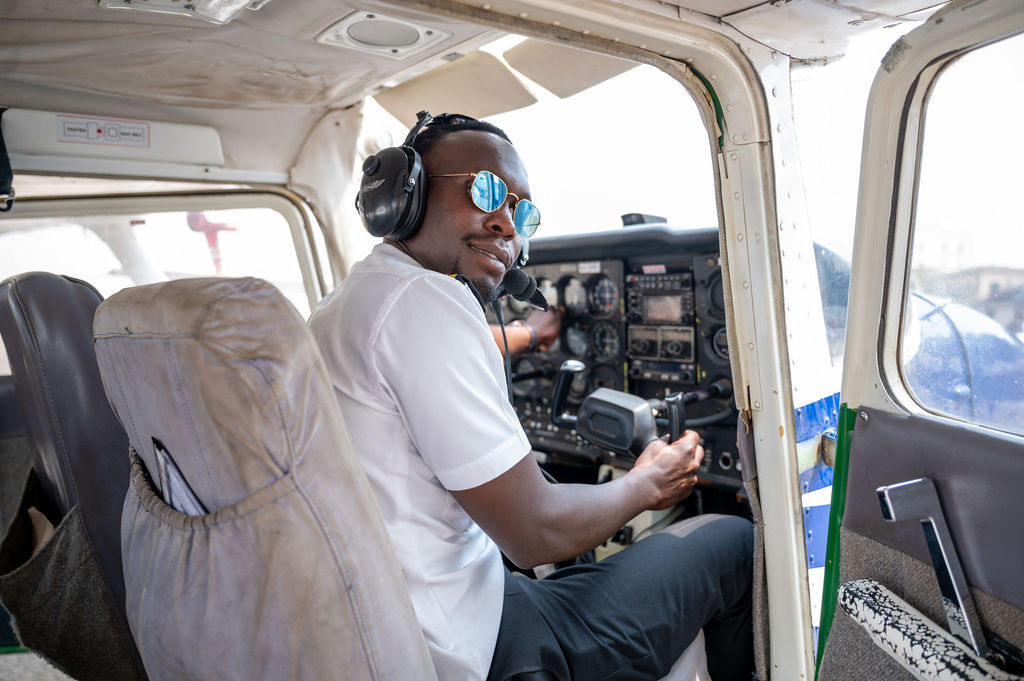
In this phase, you have the opportunity to physically operate the airplane and gain practical experience. You will train with the Cessna 152 (C152) or the Cessna 172 (C172). The C152 and C172 are popular training aircraft because they offer the best combination of affordability, safety, performance, versatility, and their stable and forgiving flight characteristics.
To obtain a PPL, you must accumulate a minimum of 40 flight hours and 200 for a CPL.
The duration of training can range from 2 to 3 years (7 months to 1 year for PPL and 2 years for CPL). Factors like the availability of school aircraft, weather conditions, and your financial resources influence this.
Once you have met the requirements for flight hours and successfully passed the knowledge test, you will be prepared for your practical test, often referred to as the “General Flight Test,” which is conducted by an approved examiner from the Kenya Civil Aviation Authority (KCAA). The examiner will assess your flying skills, which include tasks such as takeoffs and landings, and your ability to handle emergency procedures.
In addition, you can decide to add add-ons to your license.
-
Instrument Rating (IR) is a valuable addition to a pilot’s career. It offers increased safety, career opportunities, and the ability to fly in a wider range of weather conditions. In short, it enhances a pilot’s skills, confidence, and overall competence.
-
Multi-Engine Rating (MER): this will allow you to fly an airplane with two or more engines. It demonstrates a commitment to professional development and a willingness to acquire advanced piloting skills, which can attract potential employers.
NOTE: All licenses and ratings are applied through the Kenya Civil Aviation Authority after completing the required training and passing all examinations.
In conclusion, pursuing an aviation career requires careful planning, dedication, and adherence to specific requirements set by the KCAA. The stringent requirements ensure that pilots are well-trained and capable of ensuring the safety of passengers and cargo. If you are passionate about aviation and meet these requirements, you can embark on an exciting career in the skies. Remember that ongoing learning and safety consciousness are paramount in the aviation industry, making it a dynamic and fulfilling profession.